
A brief foray into the exciting world of Branding Guidelines
#sarcasm
What are Branding Guidelines?
In a nutshell, Branding Guidelines are a set of rules and advisories to help maintain a consistent brand experience. Every time a customer comes into contact with a brand they build on their perception of it; Branding Guidelines help to shape that perception to fit the underlying traits and values you want the brand to represent.
Branding Guidelines are usually presented in the form of a document outlining specific scenarios or examples of brand usage. The types of scenarios presented will vary depending on the nature of the business, but most guidelines will cover logo usage and editorial style.
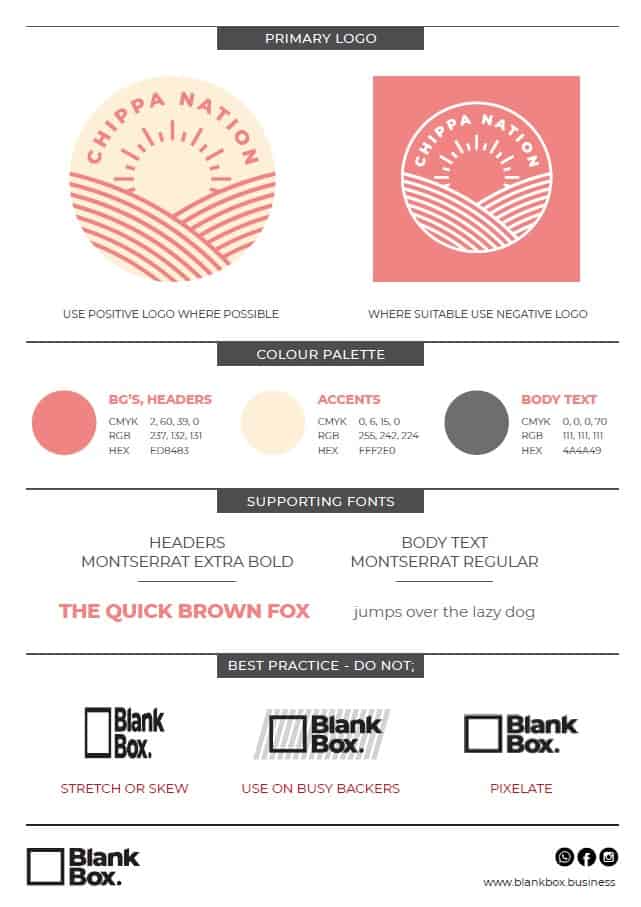
An example of a basic Branding Guidelines document covering logo usage, colours and fonts
Branding Guidelines should then be used by any party representing the brand to ensure that they represent the brand in a consistent and cohesive manner.
What should Branding Guidelines include?
How a customer interacts with any particular business will depend on the space it inhabits. A digital only business will need a different set of rules to a traditional brick-and-mortar shop.
We can still consider the likely touch-points that businesses will need to consider, and can roughly split these up into 4 categories:
1 - Visual Identity
This is the most common area for a Branding Guidelines to cover, as every business will have some kind of visual identity, usually in the form of a logo.
This can include:
- Rules on logo usage – including minimum / maximum size, context, spacing and permissions (where it can be used)
- The brand’s colour palette. These will often include CMYK values, RGB values and Hex codes to suit different uses
- Text fonts and sizes – this usually covers the full hierarchy of elements e.g. headings, subheadings, body, captions etc.
- Supporting design elements – such as backgrounds, icons and embellishments
- Photography style
2 - Interaction and Functionality
For many Brands the main contact with clients will be online. While ensuring your website style is consistent it can also be vital for easy navigation and usability to have set guidelines for interactive or functional elements.
These can include:
- Navigation elements – such as links and buttons
- Functional elements – such as cancel or submit buttons
- Modals – such as warning, error or information popups
- Formatting elements – such as padding, margins, motion effects and page layouts
3 - Editorial Style
Editorial style guides tend to set rules and show usage examples for grammar, spelling and sentence structure. They can also include guides about the tone in which the company addresses it’s audience, such as whether to speak in first person as opposed to second / third.
Some companies may adopt an existing style, whereas others may build their own individual set of standards to suit their needs.
Editorial style guides may include:
- Rules on capitalisation such as in headings
- Formatting of references and footnotes
- How in-line images are displayed
- The use of bullet points or numbered lists
- A glossary of grammatical rules and how to spell specific words
- Rules on acronyms and abbreviations of words
- The tone of voice being adopted e.g. active or passive
4 - Personality
A strong company personality can help play into the notion that when we, as consumers, speak to a business, we are speaking to an individual with a set personality, and as such can hold opinions about that company that may play into how we interact with them.
Depending on the product or service being offered, a company may want to adopt an air of sophistication, or present itself as competent and trustworthy.

An example of popular brand’s personalities. Image source
One of Microsoft’s ‘voice principles’ is to be ‘ready to lend a hand’ by anticipating their needs and offering the right information at the right time.
Other elements that may be included in a personality guide are:
- Information on your brand’s background, goals and values
- Your companies attitude to wider global movements, such as being more green
- Your brand’s defining trait (e.g. enthusiastic, sincere, rugged etc.)
How do I use Branding Guidelines?
Branding Guidelines are ultimately a collaborative tool to allow many individuals to present themselves using one aligned style. As such they need to be accessible and understandable to anyone working with your Brand – both internally and externally.
To use Branding Guidelines, you need to ensure that anybody working with your brand has read and understood the guidelines, and you need to be proactive in enforcing the guidelines if they are not followed.
Your Branding Guidelines should be:
- Concise
- Easy to read – try to avoid acronyms or jargon, and ensure translated versions are available if you anticipate international usage
- Accessible – making sure it is suitable for both digital and physical usage is an easy way to make it more accessible
4 tips for making your own Branding Guidelines
Here are some tips for ensuring that your brand guide aids in creating first-rate content:
- Start simple – when creating a brand we start our clients off with a 1-page branding basics guide, don’t be afraid to start small and add more as it’s needed!
- Use an existing style guide (such as AP Style for your editorial style). Tweak it / add to it as required
- Focus on your customer – if you’ve done research on your target market then tailor your Branding Guidelines to suit them
- Work backwards – if you’re struggling to thing of how you should present yourself, try to find examples of styles or personalities you don’t like, and build up your guide to avoid them
Want help with your Company’s Branding Guidelines? We have over a decades experience designing brands, websites and marketing materials. Just head on over to our branding shop to get started!